

Flooding is part of life in New Orleans. Heavy rain, overwhelmed drainage systems, and flash flooding can turn familiar streets into dangerous roadways in minutes. But while weather may be unavoidable, the decision to drive through standing water is still a choice — and in some cases, that choice can affect who is legally responsible after a crash.
Choosing to drive through floodwater, especially when the risks are right in front of you, can shift legal responsibility for an accident directly onto you. If you were injured in a flood-related crash in New Orleans, understanding how liability works is critical. Here’s what you need to know.
Why Flooded Roads Are More Dangerous Than They Look
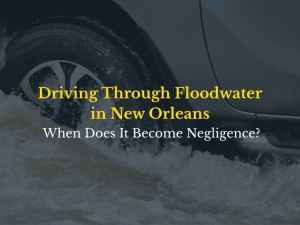
Floodwater creates risks that drivers often cannot see until it is too late. Even a few inches of water can affect traction, visibility, and braking ability. According to the National Weather Service, just six inches of moving water can cause a driver to lose control, and 12 inches of rushing water can sweep most cars away entirely.
In New Orleans, especially, floodwaters can conceal hazards beneath the surface, including:
- Large potholes or collapsed pavement
- Disabled or abandoned vehicles
- Missing manhole covers
- Debris and tree limbs
- Electrical hazards
- Damaged traffic signals or road markings
Potholes are already a fixture of New Orleans roads. Under standing water, they become invisible. Hitting one at speed can blow a tire, damage your suspension, or cause you to lose control entirely.
Floodwater can also disable a vehicle within seconds. When water enters through the air intake, it can hydrolock the engine, often leaving drivers stranded in rising water with no way to move the vehicle to safety.
Modern vehicles are also heavily dependent on electronics. Floodwater can short-circuit critical systems without warning, including brakes, airbags, power steering, and ignition systems. Water also reduces tire grip and increases the likelihood of hydroplaning, making it harder for drivers to stop or maneuver safely.
Despite these risks, some drivers continue traveling through flooded streets at normal speeds or attempt to cross barricaded roadways. The danger is that floodwater gives drivers little warning before conditions become deadly. By the time someone realizes how deep or fast-moving the water truly is, it may already be too late to recover control.
That is exactly why the law treats the decision to drive through floodwater so seriously. When a driver knowingly enters dangerous flooded conditions and puts others at risk, it may become more than poor judgment. It may become negligence
How Is Fault Determined After a Flood-Related Crash?
Flood conditions do not automatically excuse a driver from liability after an accident. Louisiana drivers still have a duty to operate their vehicles safely based on road and weather conditions. That means slowing down, avoiding flooded areas when possible, and recognizing when conditions are too dangerous to continue driving.
After a flood-related accident, courts and insurance companies look closely at whether a driver acted reasonably under the circumstances. In other words, did the driver ignore obvious dangers that a reasonable person would have avoided?
Several factors can influence how fault is determined.
Were There Visible Warnings?
If barricades were in place, roads were marked closed, or emergency alerts had warned drivers to stay off certain streets, a driver who ignored those warnings may face significant liability. Choosing to drive around barriers or through marked flood zones can be used as evidence that the driver knowingly accepted a dangerous risk.
What Did the Driver Know?
Local experience can also matter. Someone who has lived in New Orleans and driven through years of heavy storms is generally expected to understand how quickly streets can become dangerous. Courts may consider whether a driver reasonably should have known the roadway was unsafe based on the weather conditions and surrounding circumstances.
Was the Driver Speeding or Distracted?
Speed becomes especially dangerous in standing water. Driving too fast through flooded streets increases the risk of hydroplaning, where tires lose contact with the roadway and steering control disappears completely. A driver who was speeding, texting, distracted, or otherwise not paying attention during severe weather may be found partially or fully responsible for the crash.
Did the Driver Ignore an Obvious Risk?
Sometimes the danger is impossible to miss. If another vehicle had already stalled ahead in floodwater, if water levels were visibly rising, or if nearby drivers had turned around, those facts may become important evidence. Continuing forward despite clear signs of danger can strongly influence how negligence is determined.
Evidence used to evaluate fault may include:
- Traffic camera footage
- Weather and flood reports
- Witness statements
- Police reports
- Vehicle speed or braking data
- Photos and videos from the scene
Louisiana follows a modified comparative fault system beginning January 1, 2026. Under this rule, an injured person may recover damages only if they are found to be 50% or less responsible for the accident. Any compensation awarded is then reduced by their percentage of fault.
That means the focus is often on whether a driver’s decisions contributed to causing the crash. Insurance companies may argue that a driver bears some responsibility if they ignored flood warnings, drove through standing water, or failed to use reasonable caution during severe weather. But the fact that someone was driving during a storm does not automatically make them at fault. A driver who acted carefully may still have a valid claim against another driver whose reckless conduct caused the accident.
Can the City Ever Be Liable for Flood-Related Accidents?
In some cases, liability may extend beyond the drivers involved. Government entities responsible for road maintenance or drainage systems can potentially share responsibility if dangerous conditions resulted from negligence.
For example, a claim against a city or public agency may arise if:
- Drainage systems were improperly maintained
- Roads were known to flood repeatedly without warning signs
- Dangerous roadway conditions were ignored
- Traffic signals malfunctioned during flooding
- Officials failed to address known hazards within a reasonable timeframe
However, claims against government agencies are often more complicated than standard car accident cases. Special notice requirements and shorter deadlines may apply, and proving liability typically requires evidence showing the city or agency knew about the dangerous condition and failed to act appropriately.
Not every flooded roadway creates government liability. Severe weather alone is not enough. The key issue is whether negligence contributed to the dangerous condition or failed response.
What to Do After a Flood-Related Car Accident
The decisions you make in the hours right after a car accident will shape everything that follows. Here is what you should do after a flood-related accident:
- If safe to do so, move to higher ground and away from rising water
- Call 911 and report the accident
- Seek medical attention immediately
- Take photos or videos of the vehicles, roadway, flooding, and surrounding conditions (if safe and able)
- Avoid walking through floodwater if electrical hazards may be present
- Exchange information with other drivers and witnesses
It is also important to document the flooding conditions as thoroughly as possible. Water levels can recede quickly, and evidence that helps explain how the accident happened may disappear within hours.
Insurance companies often try to minimize flood-related claims by arguing the weather alone caused the accident. An investigation can help determine whether another driver, roadway condition, or negligent decision played a role in causing your injuries.
If you were hurt in a flood-related crash in New Orleans, speaking with an experienced attorney can help you better understand your rights and legal options
The Bottom Line
Flooding in New Orleans is part of life. Choosing to drive through it is not.
Every storm leaves drivers making split-second decisions: turn around, wait it out, or push forward and hope for the best. But when someone ignores visible warnings, barrels through standing water, or drives recklessly on roads they know are dangerous, the consequences can extend far beyond vehicle damage.
Under Louisiana law, drivers are expected to adjust to the conditions around them. When they fail to do that, and someone gets hurt, it may not be considered an unavoidable accident. It may be negligence.
If you were injured in a flood-related accident, you may have the right to recover compensation for medical bills, lost income, pain and suffering, and other damages. But Louisiana law places strict deadlines on injury claims, and waiting too long can affect your ability to recover.
Talk to Morris Bart Personal Injury Lawyers For Free
Flood-related accident cases are rarely straightforward. They often involve multiple parties, complex insurance disputes, and questions about road conditions, weather warnings, and government responsibility.
At Morris Bart, we have spent decades representing injury victims across Louisiana, Mississippi, Alabama, and Arkansas. We understand how these cases are investigated, how insurance companies try to shift blame after severe weather, and what it takes to build a strong claim under Louisiana law.
Your consultation is free, and you pay nothing unless we win your case.